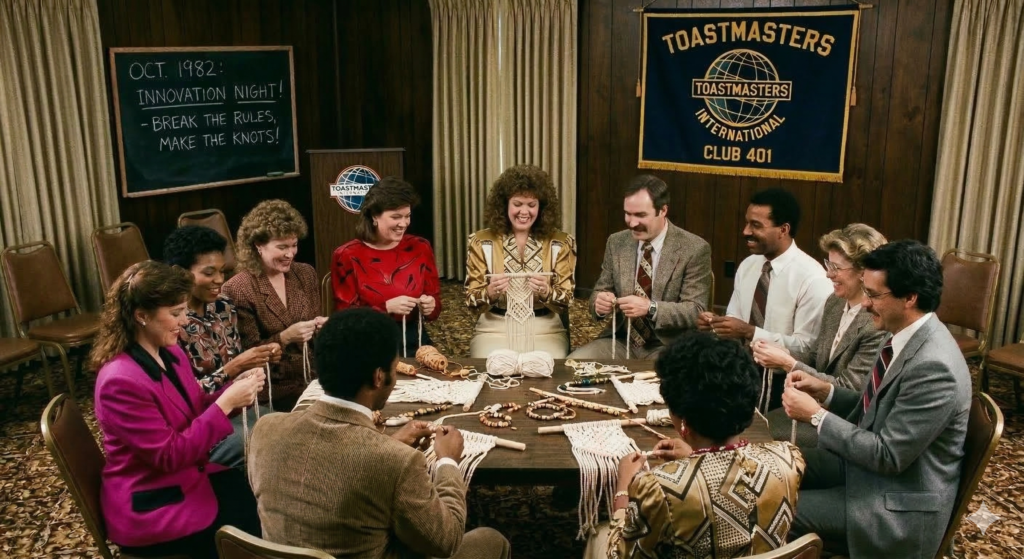
I don’t usually remember my dreams, but last night, my subconscious decided to take me back to 1982.
In this dream, I walked into a Toastmasters meeting that felt like a perfect time capsule. The room displayed a sea of power suits, massive shoulder pads, and perms that defied gravity. These members represented the “Old Guard”—the dedicated leaders who had served as the backbone of the club for years.
Although they were loyal and disciplined, they were also clearly exhausted. As a result of watching them, I realized they were going through the motions with a weary, bureaucratic precision. The meeting did not feel like a place of growth; instead, it felt like a group of people trapped inside a rigid, laminated cage. Essentially, they were locked inside their agendas.
The Breakout
Consequently, I looked at the group and asked a question that rippled through the room like a shockwave: “Who says every meeting has to follow this exact script?”
In response, the room fell silent. A few members confusedly adjusted their oversized, plastic-rimmed glasses.
Since dream-logic rarely makes sense, I pushed even further. I suggested that we stop the formal speeches for one night and host a hands-on Macramé workshop. First, we ditched the neat rows of chairs and moved into a circle. Next, we brought out the cord and the beads. Instead of a lectern, we created a collaborative workspace. We even conducted Table Topics right there in the circle, with questions centered around the frustration of a tangled knot. Finally, an evaluation followed, and—voila!—we enjoyed a themed meeting where members laughed and shared. Indeed, they learned exactly as Dr. Ralph Smedley suggested: “in times of enjoyment.”
The Lesson: Escape the “Status Quo” Cage
When I woke up, the humor of the “Power Suit Macramé Circle” faded, but the message remained crystal clear: Too many clubs are stuck. In fact, through recent discussions with District leaders, I’ve noticed a growing tension between newer members and long-standing veterans. While the new members want to experiment and innovate, the older members often strive to protect the status quo.
The irony is that many veterans believe they are staying true to Dr. Smedley’s original vision by sticking to a rigid, unchanging format. However, they aren’t. If you study Smedley’s writings, you will find a man who championed purposeful innovation. He did not build a monument to “how things have always been done”; rather, he built a platform for personal evolution. He knew that if the “enjoyment” died, the growth would soon follow. Therefore, when we refuse to change, we aren’t honoring the founder—we are just polishing the bars of the cage.
A Call to Boldness
Ultimately, let’s stop fearing the escape from the prison of the static agenda.
If we want to keep our clubs vibrant, we must try something bold. Furthermore, we must lead with passion and purpose. That one “unorthodox” meeting idea—whether it’s a skill-share, a mock debate, or an outdoor workshop—might be the very spark that reignites a struggling member’s interest. In the end, it might be the fire that transforms a stagnant club into a thriving community.
Don’t let your agenda be a script for boredom. Instead, let it be a launchpad for creativity.
Disclaimer: The information on this website is the sole expression of the author and does not necessarily reflect the opinion or endorsement of Toastmasters International. The Toastmasters trademarks and logos used in the accompanying imagery are for illustrative and educational purposes only. For official brand guidelines, please visit Toastmasters.org.
What is one “bold” change you’ve been itching to try in your club? Let’s brainstorm some “Agenda-Busters” in the comments.